
HOUSTON, TX – On Octubre 8, 2026, the EPA issued letters to all 50 states about whether or not they are officially meeting federal air quality standards (called NAAQS) for Particulate Matter 2.5 (PM2.5), or particle pollution. In direct opposition to data from Texas’ own environmental agency, the EPA has declared that all counties in Texas are meeting the federal gold standard for PM2.5, which was at the Governor’s request, and a contradiction to his own agency’s data.
Being officially deemed in “attainment” for PM2.5, when our data say otherwise, has direct implications for Houston. Now, neither industry nor regulators will have to make mandatory changes to improve air quality as it relates to PM2.5. However, an accurate non-attainment decision would require a State Implementation Plan (SIP) of mandatory actions to reduce particle pollution. In addition, and because our modes of transportation emit a large amount of PM2.5, it would also add rigour to the approval of new transportation plans, programs, and projects including freeway expansions in Harris County. Lastly, a non-attainment determination would add a new layer of accountability to air permits issued by TCEQ for facilities such as Concrete Batch Plants and rock crushers.
PM2.5 is one of the most harmful air pollutants for health, penetrating deep into the blood stream and organs. Multiple studies over decades show a definitive link between short-and long-term exposure to particle pollution and poor health outcomes including respiratory and cardiovascular diseases, poor birth outcomes, and even poor mental health. Recognizing this, the EPA strengthened the gold standard for PM2.5 in 2024 to reduce this pollutant by 25% nationwide, thereby saving 4,500 lives per year across the country.
The public has until Noviembre 5, 2026 to weigh-in on EPA’s decision for Houston/Harris County. Comments can be emailed directly to the EPA at [email protected] (type Docket ID No. EPA–HQ–OAR–2024–0078 in the subject line of the message). By Febrero 2027, the EPA must issue final and binding designations for every state and County.
Quotes from residents of Harris County who are living in the neighborhoods where TCEQ regulatory monitors show the highest PM levels in Harris County:
Traci Donatto, resident of Deer Park, TX:
“The last thing our community needs is government officials and agencies telling us how healthy our air quality is when we have known and lived otherwise. It is clear that neither the governor, nor TCEQ or EPA have come here and breathed in the air surrounding us right now, otherwise they wouldn’t be going ahead with this decision.”
Pat Gonzales, resident of Pasadena, TX:
“There is always a great need to lower the PM levels because it does affect the community. I would like to see stricter regulations and hold these entities accountable for what they put into the air. We need to be put on the right category so that way the federal government knows we need higher regulations”
Juliana Hernandez, resident of East Aldine, TX:
“Frankly, I feel insulted but not surprised that the Governor would push to claim that Texas is in compliance with PM 2.5 standards. He is clearly not breathing the same air as other Texans, and clearly he is not taking the time to read air monitoring reports like those of us who do so routinely to keep our families safe and healthy. The current EPA, the TCEQ, and the Governor have shown Texans, particularly Harris County residents that they prioritize industry interests over our health and livelihoods. As a resident of East Aldine, which has one of the highest concentrations of concrete batch plant facilities in Harris County, who has been hospitalized from breathing complications, I believe it is important that we come together as a community and stand firm against policies that harm our health.”
Helen McKay, resident of Baytown, TX:
“I am constantly thinking about what is in the air. My family’s house has gas appliances, but the builders did not make a venting system for it. They got around that regulation by saying you could just open the windows; let the bad air out, let the good air in. But is the air outside really much better? I have an autoimmune disease; maybe the air gave it to me. Some days I step outside and start gasping for breath. I get a stabbing pain between my ribs. My father has scarring in his lungs from bouts of pneumonia years ago, during the pandemic. The bad air doesn’t help. On the worst days, he gets in coughing bouts so intense he can’t breathe. We have to pound on his back to give him relief.”
Abbie Kamin, Harris County Attorney:
“We’re past the point of debating the impact of pollution on our health, safety, and our planet. The EPA has a legal obligation to protect our communities, not take us back in time. Texas’s own monitors show our air quality violates the standards already in place—pretending otherwise puts the health of our children, seniors, and neighbors at risk. Harris County families deserve the truth about the air they breathe. My office will be submitting federal comment and I appreciate the work of Air Alliance Houston to bring attention to this.”
Jennifer Hadayia, Executive Director of Air Alliance Houston:
“The decision by the EPA, the Governor, and the TCEQ is arbitrary and inaccurate. The state’s own regulatory air monitors show Harris County exceeding every PM2.5 standard due to the proliferation of soot-polluting industry as well as our sprawling transportation system that breeds tailpipe pollution. This attainment determination is blatantly ignoring data, not making our air cleaner, and it glosses over the real experiences of Houstonians who are breathing this dirty air every day.”
Anthony D’Souza, Manager of Community Air Monitoring at Air Alliance Houston:
“Actual PM2.5 pollution doesn’t disappear because the Governor declares it so. Multiple public health authorities charged with analyzing air quality have confirmed that Houston’s PM2.5 levels are unhealthy and exceeding the NAAQS. Our own extensive community air monitoring network across Houston/Harris County shows the same, year after year. The most recent year’s worth of community air monitoring data (graph below) from Air Alliance Houston shows average PM2.5 concentrations across all communities above the current NAAQS of 9μg/m3 and many above the older standard of 12μg/m3.”
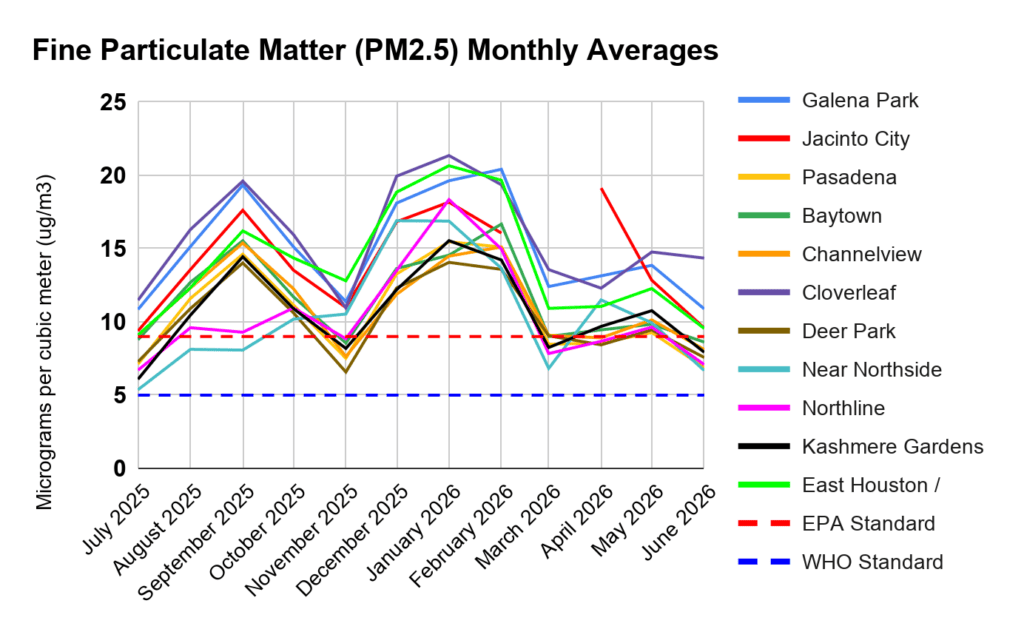
Source: Air Alliance Houston, Community Air Monitoring Program (CAMP), Julio 2025 – Junio 2026
Jen Powis, Managing Attorney, Gulf Regional Office, Earthjustice:
“Texas is ignoring science and blaming air pollution on other countries. The state cannot lawfully disregard our everyday reality—and doing so puts Texans’ lives at risk. Soot pollution, also known as PM2.5, comes from, for example, tail pipes on cars and trucks, large industrial sources like refineries, and small combustion activities like garbage incinerators. These microscopic particles travel deep into the lungs and enter the bloodstream, increasing the risk of heart attacks, strokes, asthma attacks, and other serious respiratory illnesses. For more than two decades, our federal Clean Air Act has worked to control that pollution, making it easier to breathe everywhere. Texas should not ignore science, and the evidence is clear, the harm is real, and the consequences for Texans are serious. Governor Abbott should focus on controlling pollution, not dismissing the damning data.”