
Ashley Zhang / Opal Lung / Dr. Inyang Uwak, Dr. Inyang Uwak, DrPH, MPH, MD.
Air Alliance Houston Intern / Rice University Student / Research and Policy Director
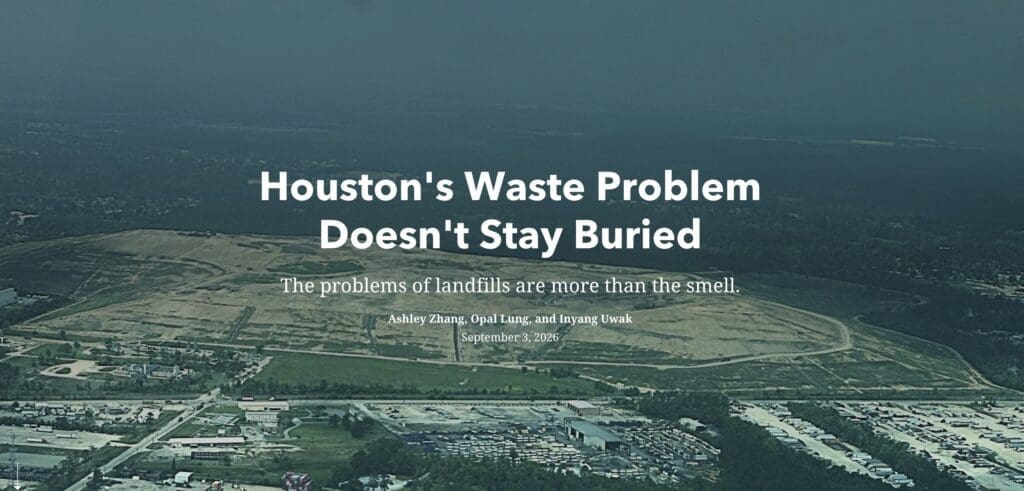
The problems of landfills are more than the smell.
We are all familiar with Houston’s sweltering summers. Sweat beading down your face as you step out of your home, as the sun beats down on your back. Yet Houston’s extreme heat is more than an inconvenience; it can have serious consequences for human health. In 2026, heat-related illnesses contributed a high percentage of emergency department utilization across the Houston area. Compared to 2025, the number of heat-related hospital visits and the length of stay have increased. But it is only going to get hotter and hotter each year.

From 2025 to 2026, the number of extreme heat days has only increased in Houston. 2024 marked the hottest year in a 175-year observational period with a global mean near-surface temperature of 1.55°C above the pre-industrial average. Every additional 0.1°C of global warming leads to pronounced climate anomalies, with extreme heat becoming an increasingly significant public health risk in Houston.
Methane is a potent greenhouse gas with a much greater short-term warming potential than carbon dioxide. Because of this, achieving significant reductions in methane emissions would have a rapid and substantial effect on global warming.
According to Air Alliance Houston’s 2023 “Dirty Dozen” report , the waste industry generates the greatest amount of methane emissions of any industrial sector, contributing to about 78% of total methane emissions in Harris County overall, based on data collected from 2018-2022. Four of the top five methane emitters in Harris County were landfills.
A reduction in methane emissions from landfills, therefore, serves as a critical local opportunity to support climate change mitigation efforts. If we want to limit the heat Houston faces tomorrow, we have to act on the methane we emit today.
Read through our other story maps by clicking here!