

Anthony D'Souza
Community Air Monitoring Programs (C.A.M.P.) Manager
The Community Air Monitoring Program (CAMP) at Air Alliance Houston is currently working to expand its presence into five new communities within the Greater Houston area:
- Texas City
- East Aldine
- Greater East End / Meadowbrook
- La Porte
- Conroe
These particular areas were chosen since they possess numerous sources of air pollution yet currently fall within gaps in the region’s existing air monitoring zones. To remedy this, we are gradually building a network in each of these communities consisting of five particulate matter air monitors deployed at strategic locations to capture an accurate overview of their air quality.
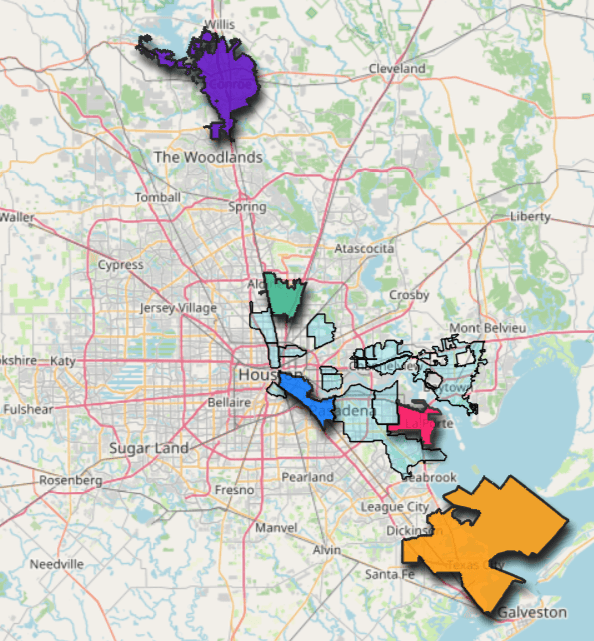
Figure 1: Location of new communities in relation to existing CAMP neighborhoods in light blue
Residents of these areas have reported poor air quality and related health impacts for decades. While conducting outreach efforts and installing these monitors at their homes, we’ve had the opportunity to listen to their concerns at a deeper level, a few of which are summarized below:
- In the East End, residents reported unbearable chemical odors and respiratory symptoms during the Mammoth Metal Recycling fire located barely 300 yards away as they watched a thick pillar of unrelenting smoke tower over their neighborhood
- AAH monitors measured significant spikes of PM2.5 as far as 4-5 miles downwind of the fire. It is highly likely that levels in the East End were much higher.
- In East Aldine, residents spoke about the layers of white crystalline silica dust that coat their yards, cars, and plants every morning, released by the heavy cluster of concrete plants, rock crushers, and other aggregate facilities sited in the neighborhood.
- In Texas City, residents experience powerful fumes that confine them to their homes every time the wind blows in from the south, bringing in emissions from the sprawling industrial complex located down below

Pictured above: Mammoth Metal Recycling Fire. Photo Credit: Daniel Holiday
By installing these monitors at residences, schools, and locations where people spend the vast majority of their time, we hope to capture a more accurate picture of neighborhood-level air quality than provided by our state regulator, the Texas Commission on Environmental Quality’s (TCEQ) regulatory monitors.
While often boasting about hosting “one of the most robust air monitoring networks in the country”, the TCEQ routinely locates these taxpayer-funded monitors miles from impacted communities and the places where they live, work, and play. Oftentimes, these monitoring stations barely even measure high-priority contaminants of concern. For example, across La Porte, the Greater East End / Meadowbrook area, and Texas City, the TCEQ doesn’t maintain a single monitor that measures PM2.5 – despite it being the most deadly air pollutant and a Group 1 carcinogen, causing millions of premature deaths worldwide every year.
Why now?
These monitors were provided by the American Lung Association (ALA) this year as part of their larger public health intervention to Reduce the Lung Health Burden of the Climate Crisis. This initiative seeks to provide resources, education, and tools to healthcare providers, community organizations, and people with lung disease. By increasing public access to localized air quality data, especially within those communities highly burdened by air pollution, the ALA aims to empower residents to better understand local threats to their air quality as well as their human health impacts.
Houston was one of only 3 locations nationwide chosen for this campaign due to the area recording some of the highest levels of ozone and particulate matter pollution across the entire U.S. Every year, the ALA grades counties based on their air quality as part of its State of the Air report. These grades are calculated by the number of days a county’s air reaches unhealthy levels and each day is weighted by how polluted it gets. This year, Harris County received a failing grade in both Ozone and Particulate Matter, continuing its decades-long trend of violating federal air quality standards.
The Greater Houston region also ranked:
- 6th worst by ozone pollution out of 226 metropolitan areas
- 8th worst for annual particle pollution out of 211 metropolitan areas
Expanding air monitoring capabilities in those neighborhoods that currently lack them is the first step to solving this issue. With greater public awareness comes the ability to know when levels of air pollutants are high, how high they are, what action to take in response, and when to take it. Our Community Air Monitoring Program works to deliver grassroots data to residents on the quality of their air both during short term pollution events as well as tracking longer term trends. This new buildout is still underway, with around 15 monitors left to deploy primarily in Conroe, Texas City, and La Porte. Reach out to us if you live in those communities and have concerns about the quality of your air!
Bigger picture
It’s worth noting that this initiative is needed now more than ever. In 2025, the TCEQ analyzed its air monitoring data across the state to prepare each county’s compliance status with national health-based PM2.5 standards. It designated:
- Three counties exceeding the older 12 ug/m3 standard and
- Fifteen counties exceeding the newer 9 ug/m3 standard
Harris County was in both of those groups. This designation meant that the county would have to take mandatory steps to reduce its concentration of PM2.5 including stricter industrial permitting, stronger emission controls, improved transportation planning, among other measures.
Instead of heeding this alarming data and preparing to improve our air quality, the Governor unilaterally declared the entire state’s air quality to be within healthy limits – blaming this pollution on external sources without any concrete evidence. Rather than standing by its own data and analyses, the TCEQ instantly bowed down to his declaration and agreed. Our national regulators, the EPA, followed suit spinelessly as well – issuing a letter on October 8, 2026 that officially declared all counties in Texas in compliance with federal PM2.5 standards.
Data and empirical evidence however reveals truths about our air quality, and the truth couldn’t care less about those in power, corporate profits, corrupt state regulators, and misguided declarations. The truth will continue to exist every day, in the air, in our lungs, in our bloodstream, and ultimately in our health outcomes – regardless of who is in office. Their refusal to acknowledge this data doesn’t make it false. All it does is prevent vital action from being taken while sacrificing our health in the meantime, as they go around appeasing those who continue to pollute our air.
Want more information on our Community Air Monitoring Network or learn about your air quality? Check out these links: