
Dr. Inyang Uwak, DrPH, MPH, MD
Research and Policy Director
This series is in conjunction with our latest report, "Emissions Events in Harris County, 2017-2024."
What Industrial Emissions Mean for Our Communities
Families who live next to Houston’s Ship Channel wake up each day not knowing what the air will bring.
For part 3 of our Emissions Events series, we interviewed residents from fenceline communities—neighborhoods located right beside refineries and chemical plants—share how pollution shapes their daily lives.
“Sometimes there’s a strange smell. Sometimes it’s flaring. Sometimes it’s both,” one resident and Air Alliance Houston’s Government Affairs and Community Outreach Director, Leticia Gutierrez says. “You never know what you’re going to wake up to—or how it will affect your kids or your neighbors.”
For years, many people learned to ignore the smoke, fires, and odors. “I didn’t know much about emissions back then,” another resident and Air Alliance Houston’s Outreach Coordinator, Diamond Pham, explains in the video. “I just knew there was fire and weird smells. I got used to it. I didn’t think about what it could do to our health.”
But learning more made the impacts impossible to ignore.
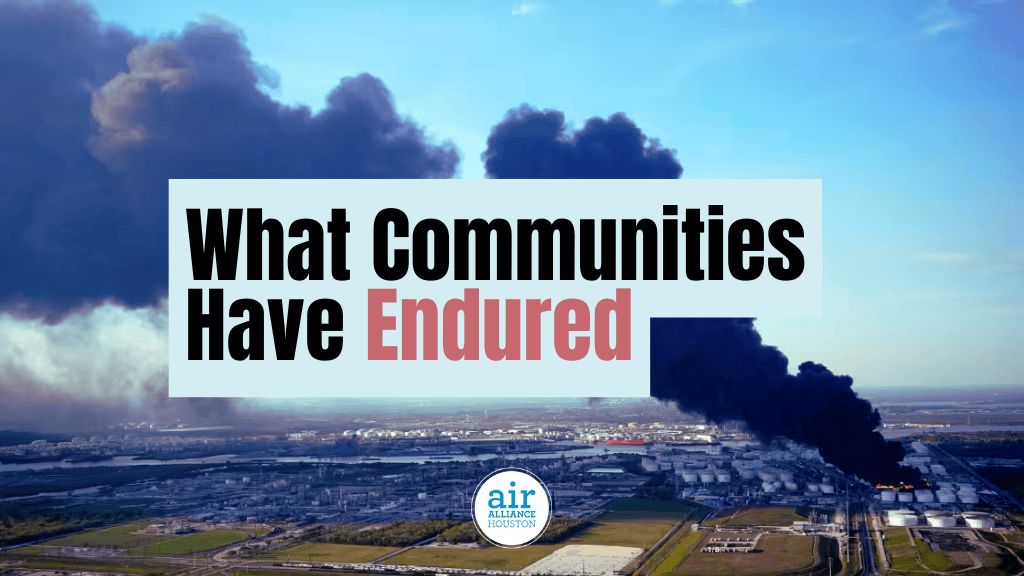
Both Leticia and Diamond talk about family members with asthma, repeated attacks that send children to the hospital, and loved ones lost to lung cancer. They also recall the fear during the 2019 ITC fire, when smoke spread across neighborhoods and parents scrambled for answers about whether it was safe to go outside or pick up their kids from school.
Leticia and Diamond say these moments reveal a broken system—one that allows routine flaring, weak fines, and too little warning for the people most affected.
Fenceline communities are calling for change: more air monitors in neighborhoods, clear public data, real community input, and stronger enforcement for repeat polluters. Research shared alongside their stories shows high asthma rates in the East End and higher cancer risks for children living near the Port.
These residents are taking their experiences—and the science—straight to lawmakers.
Watch the video below to hear directly from people living on the frontlines of industrial pollution, and learn why they are demanding cleaner air and real accountability.
What can you do about it?
- Speak up and mobilize your community. Share this information with your neighbors, schools, and local organizations to build awareness and collective power.
- Contact your elected representatives. Demand the Safer Communities by Chemical Accident Prevention rule (formerly RMP rule) does NOT change as it provides stronger air quality protections and better enforcement that can prevent these events from happening.
- Stay informed and ready to act. Sign up for our newsletter to get updates on air quality issues, upcoming permits, and opportunities to take action in your area.
In the event of a chemical emergency…
- Bring family and pets indoors and listen to local radio or TV stations for instructions and updates.
- Follow the instructions of local emergency officials.
- Grab your 3-day supply emergency kit.
- Gather important personal items and documents.
If told to evacuate:
- Wear full coverage clothing and sturdy shoes.
- Take your pets with you.
- Use the travel routes specified by local authorities.
- Maps of your area, preferably waterproof and non-digital.
If sheltering-in-place:
- Turn off air conditioners, heaters, and fans.
- Seal windows and doors.
- Go to an interior room without windows.
- Remain indoors until alerted by authorities that it is safe to exit.
For more information, go to:
Check out some of our other research and reports regarding emissions in Houston/Harris County:
- 88% of All Unauthorized Pollution Came From Just 12 Facilities, Pt. 2
The Truth about Emissions Events: Naming what is really happening in Houston, Pt. 1
- Houston’s Dirty Dozen: a report on the top industrial polluters.
- How Industrial Emissions in Harris County Impact Asthma Rates and Excess Deaths
- Air Alliance Houston’s Full Research and Report Library