

Dr. Inyang Uwak, DrPH, MPH, MD
Research and Policy Director
A Repeating Pattern
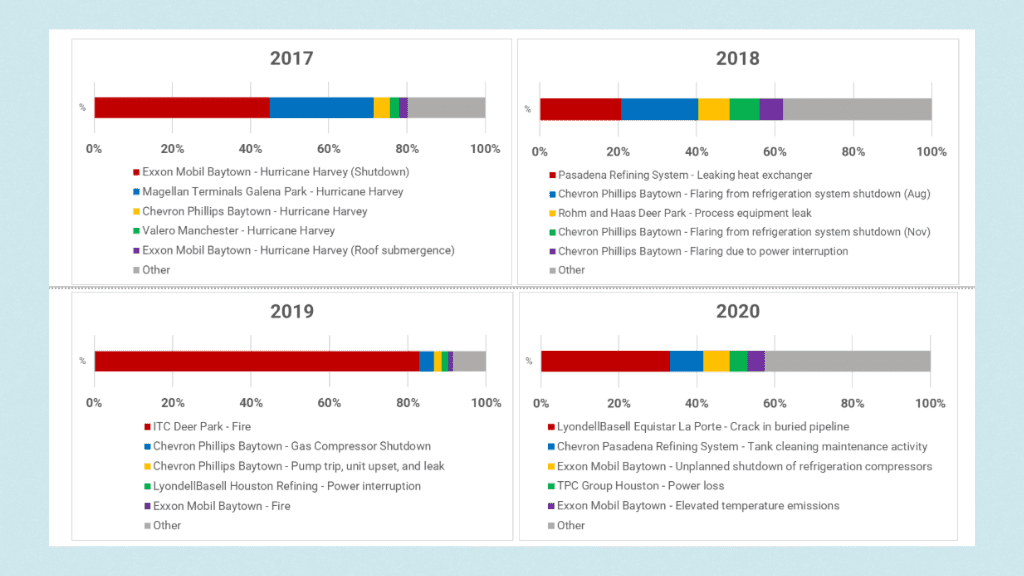
This trend of a few massive emission events that dominate an entire year’s worth of emissions repeats itself every year in the Houston region.
Over every year of the period studied, the pollution released from the five largest emission events contributed nearly half of all pollution from emission events reported over that year.
In some years, that percentage even reached as high as 80-90% of the total annual emissions reported.
Few Events, Massive Harm
On average, Harris County reports over 200 emission events annually. Although five incidents represent just 2.5% of all reported events, they contributed nearly 50% of total emissions.


The 12 Repeat Offenders
From 2017 to 2024, more than 160 facilities across the county reported at least one emission event. However, over 88% of the total air pollution from all these events originated from just a dozen of them, listed below.

The frequency of reported emission events is another key metric that helps identify facilities at high risk of accidents, fires, explosions, malfunctions, shutdowns, and other incidents.
While the TCEQ’s database recorded 1,735 different emission events over the past eight years, nearly 45% of these occurred at the same 12 facilities, as shown in the graph below.

Violations are Routine
Of the 161 facilities that recorded an emission event over the past eight years, 148 of them (more than 91%) reported at least one exceedance.
The 12 “repeat offender” facilities previously identified have cumulatively recorded over 60% of all exceedances reported during emission events since 2017. ExxonMobil’s Baytown Refinery topped the list with 948 exceedances, averaging approximately 118 every single year.

Enforcement Failed
Texas has some of the least stringent industrial emissions regulations in the country.
97% of violations recorded by large industries go unpunished.
The agency’s own Sunset Review Commission – a commission that evaluates government agencies/programs every 12 years to ensure efficiency and accountability – in 2023 labeled them a “reluctant regulator” that often leave “industry members to self-govern and self-police.”

What can you do about it?
- Speak up and mobilize your community. Share this information with your neighbors, schools, and local organizations to build awareness and collective power.
- Contact your elected representatives. Demand the Safer Communities by Chemical Accident Prevention rule (formerly RMP rule) does NOT change as it provides stronger air quality protections and better enforcement that can prevent these events from happening.
- Stay informed and ready to act. Sign up for our newsletter to get updates on air quality issues, upcoming permits, and opportunities to take action in your area.
In the event of a chemical emergency…
- Bring family and pets indoors and listen to local radio or TV stations for instructions and updates.
- Follow the instructions of local emergency officials.
- Grab your 3-day supply emergency kit.
- Gather important personal items and documents.
If told to evacuate:
- Wear full coverage clothing and sturdy shoes.
- Take your pets with you.
- Use the travel routes specified by local authorities.
- Maps of your area, preferably waterproof and non-digital.
If sheltering-in-place:
- Turn off air conditioners, heaters, and fans.
- Seal windows and doors.
- Go to an interior room without windows.
- Remain indoors until alerted by authorities that it is safe to exit.
For more information, go to:
Check out some of our other research and reports regarding emissions in Houston/Harris County: